Monday, 24 April 2017

6. Malta - Mdina


Yesterday we took two buses and visited the ancient city of Mdina, situated on a plateau roughly in the centre of the island.  I wish we had done this first, rather than last.


When you look out over the huge fortified city walls to see Valletta (the entire expanse on the horizon) so close, you realise how small the island really is. The long and tedious bus rides we have had through traffic in the built-up areas and to the island of Gozo give a bit of a false impression.

This was our first glimpse of some horticulture, too. The EU classifies Malta as 95% urban and horticultural land does not necessarily have a residence attached. But the land is very stony, with stone used to construct walls between fields, so the fields are quite small compared to what we are used to.


But back to Mdina. Mdina was first settled in the eighth century BC by the Phoenicians. It was taken over by the Romans in 218 BC. It is said St. Paul the Apostle was shipwrecked on Malta in 60 AD and spent several years in Mdina.  After the fall of the Western Roman Empire, Mdina contracted to be virtually uninhabited until 1048 when it was resettled by an Arab muslim community and its slaves. This is when it took the name Mdina, from the Arabic.

Next it was taken by King Roger the First of Sicily in 1100 AD.  By the fourteenth century the population of Malta was around 10,000 and was now under Spanish rule.


The Order of St John took over Malta in 1530 and maintained control until Napoleon Bonaparte seized the country in 1798 surrounding it to the English two years later.


This is St. Paul's Cathedral inside the city walls of Mdina.  It is dedicated to St. Paul the Apostle. The cathedral was founded in the 12th century, and according to tradition it stands on the site where Roman governor Publius met St. Paul following his shipwreck on Malta.


The original cathedral was severely damaged in the 1693 Sicily earthquake, so it was dismantled and rebuilt in the Baroque style between 1696 and 1705. The cathedral is the seat of the Roman Catholic Archdiocese of Malta, and since the 19th century this function has been shared with St. John's Co-Cathedral in Valletta.


Very baroque!


Most of the cathedral's floor floor consists of inlaid tombstones or commemorative marble slabs.   Apparently the remains of several bishops and canons, as well as laymen from noble families, are buried here.
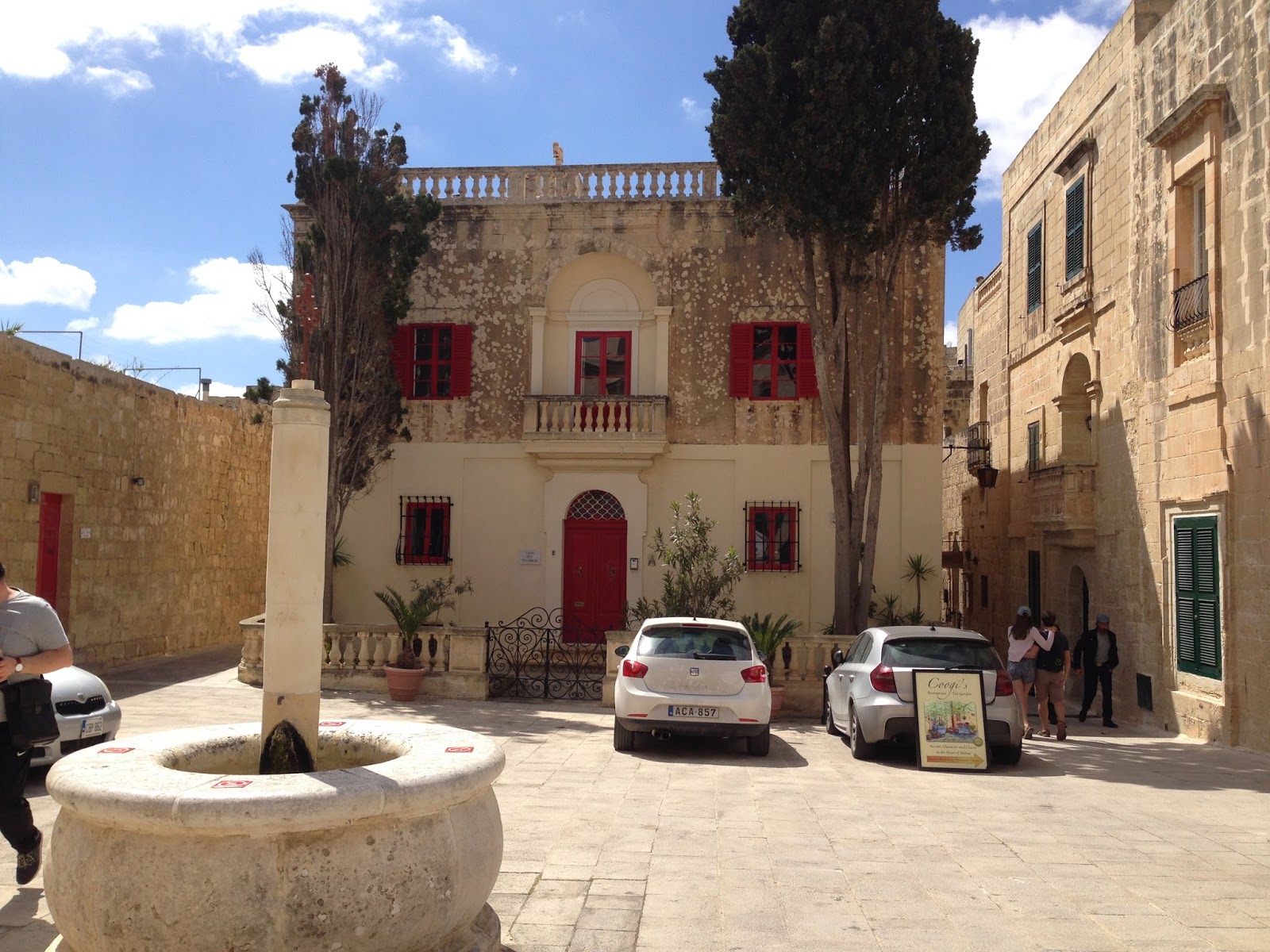

People still reside inside the walled city, in fact it is very upmarket real estate. Around 860,000 euros for a 3 bedroom restored property - $1.25m AUD.


We had a drink on the sunny part of this terrace with this lovely, colourful donkey, before heading back to the bus stop.

Farewell Malta.  Next stop - Sicily.

Saturday, 22 April 2017

5. Malta - Valletta & Gozo


The number 13A bus from St Julian's to Valletta takes the waterfront road. It is only 8 km but takes almost an hour because of the traffic congestion, especially in the late afternoon.  Having traversed the waterfront by bus and on foot, we decided to see what it looked like from the water.


So we took a one hour boat tour of the Grand Harbour of Valletta.  The harbour is very deep and it is easy to see why Malta has always been of such great strategic importance as a naval base for other seafaring nations. Being only 80 kms south of  Italy (Sicily), 285 km east of Tunisia and 333 km north of Libya,  Malta lies in the path of all shipping routes through the Mediterranean.


Malta has been invaded and subsequently ruled by the Phoenicians, Carthaginians, Greeks, Romans, Byzantines, Moors, Normans, Sicilians, Spanish, the Knights of St. John, French and finally, the English. And so, it is a nation of fortifications and its history seems to be based on war. 


Malta in now a neutral republic and a full member of the European Union. The capital, Valletta is a UNESCO World Heritage site with 85% of restoration and redevelopment paid for by various European Union funds.


The fortifications are mightily extensive, so much so that many sections may never be restored.


Those parts that have, such as Fort St Elmo and the National War Museum have been beautifully treated.


Much of the harbour area is protected by these very high and very broad bastion walls.


The tops of the walls hold arcades, monuments, gardens and fabulous views of the harbour.


Valletta was heavily bombed during WWII explaining the amount of restoration needed and the length of time it is taking. This bell was on the HMS Illustrious that was attacked at sea by both German and Italian aircraft but managed to limp back into Valletta harbour and safety, minimising loss of life.


The 17thC opera house was lost to bombs.  The metal structure inside the old facade (helping to stabilise it) is an outdoor theatre.


The French occupation by Napoleon Bonaparte left Malta with a number of treasures.  Several beautiful buildings like this one, the institution of a republic, abolition of the old feudal system that had existed under the Knights of St. John, patronage of the arts and last but by no means least, schools!


This is the Malta Stock Exchange.  In all of our travels we have never before found the stock exchange in the town square.


As the restorations progress they include some wonderful pieces of public art. This one moves like the wind that never seems to stop.


And lovely architecture - can you guess which way is west?


Some things still have a way to go - like the electric taxi charging station!


On one of the few days without rain last week we took the bus to the far north of the island, a short ferry trip to the island of Gozo followed by another bus to the cittadella in Victoria.


The cittadella is beautifully restored with the beginnings of gardens in these lower areas.  In France, England and Westeros where there is plenty of rain, these would be called moats and filled with water. But here, where there is little rain, they are called ditches and were filled with rock.  They are now home to lilac trees in bud. Good luck with that one, Gozo!


There are very few tall trees on Malta and most scrub is low, sparse and infected with prickly pear. But here at the Gozo bus terminus we found these eight magnificent white barked trees, seemingly topiarised.
The round trip to Gozo took us seven and a half hours, five hours of which was spent either in transit or queuing. We couldn't face another bus ride and another queue to see the prehistoric temples - so we headed home.


Our next outing was Paul's choice. We took the EX4 bus to Malta's container port.  Paul was overwhelmed by the size of it, thinking it almost as big as Webb Dock in Melbourne.  For a population of about 420,000 people it indicates the huge reliance on imported staples.  

For those of us sensitive to the pressures of climate change, the issues here are clear - the need for a clean renewable energy network, the difficulties to be faced without adequate water supply in an area of low rainfall, urban communities completely reliant on petrol driven transport and a food system  no longer locally controlled. The future for Malta looks worrying.  

As I write this I am looking out a window at a traffic jam at 7.40 pm on a Saturday evening in a residential area where I can see nine busses and about 350 cars at a standstill in a 500m stretch of two lane road. Maybe St. Kilda or Brighton would be the same, but only 420,000 people live here.


This neighbourhood, with its attractive 4 storey waterfront houses and pristine rock and sandy beach is opposite the container terminal. While the sky is blue and there are no waves, don't be fooled ... it is 16 degrees.


Tuesday, 18 April 2017

4. Malta - Saint Julian's & Valetta

Well, we're in Malta.

We've been here 24 hours. The best thing so far is the strawberries, but I am sure it will be wonderful once I relax into it.


We have settled in to our nice little apartment on the main strip in Saint Julian's opposite the town swimming pool, which is on the waterfront.


The entire area is either a construction zone or a demolition zone, depending on the stage at which you encounter the consrtruction.  Our stage is demolition - jack hammers and great chunks of concrete crashing into tip trucks. And someone keeps blowing a very loud whistle; I'm not sure if that is coming from the demolition or the traffic warden directing chaotic traffic around a house removal.


From our tiny balcony we look across Saint Julian's Bay.


The weather has been very unpleasant - clear blue skies but only about 17 degrees and incredibly windy. No-one ventured out yesterday except to find dinner at 8.00pm and by that stage everyone was in boots, puffer jackets or parkas and woolly scarves.  Except for one guy who was in shorts and thongs.


Today was much better. Sunny, 22 degrees with only a light wind.  So we bought a weekly bus ticket, which will take us anywhere on the island we want to go, and set off for ancient Valetta, ten minutes along the coast road.


I'm sure this was the most popular lunch spot in Valetta for local CBD workers, not many tourists here. The locals must be happy to see the warm sun again after a stormy beginning to Spring.  

They lost one of their national treasures - a rock bridge similar to one of the Apostles in Port Campbell. Demolished in a big Spring storm.


We admired the handsome Maltese veranda/balconies on the sandstone buildings in the main square. 


There were many less salubrious but equally elegant ones in the side streets.  

I honestly don't know if they are considered to be balconies or verandas .... obviously more reading is required on my part.  

However, I do know that they are temperature controllers.  It gets into the 40s here all Summer,  so I am guessing that means these constructions act as air coolers in Summer as well as clothes driers in Winter.


We opted for the 90 minute harbour cruise in place of our usual choice - the hop on-hop off city bus.  After all, Valetta is a city with an extremely deep harbour and an exceedingly long Mediterranean waterfront, one that it has needed to defend for all of its existence.


The harbour is therefore encircled by ancient fortifications and bastion walls that have been maintained for 2,000 years, firstly by the Knights of Malta and subsequently, by their allies.  Malta was a major British and Allied base during WWII.


Somewhere on our walk we passed Paul's Store.  "Old, fading and rough around the edges".  His words, not mine.


There were many horse drawn vehicles. While replicating past modes of transport, travelling mainly quite streets and resting is some modicum of shade, it is surely a practice we should not sanction or support.

And while I'm on my soapbox, Malta is very close to Africa with Algeria and Libya its closest neighbours. And yet there appears to be no recent immigrant/refugee population here. There are no beggars or street sellers at all.  I have not once been approached in the street and asked to buy something or asked for money.  All of the obviously African population that live here are working, as evidenced by publicly visible albeit low-level jobs and/or have families, as evidenced by the number of women in the supermarket and on the buses with babies and children. However, the numbers are surprisingly small for a wealthy community so close to Africa.  Once again, more reading required on my part.


We finished the day with a beer in the sun on the Saint Julian's waterfront near Paceville. So nice - so warm - so gentle.


Sunday, 16 April 2017

3. Our apartment in Rome


In response to those who have asked where we are staying in Rome and how we find the apartments we book, here is a brief run-down.


Our apartment is 23 via degli Ibernesi, in the I Monti district of Rome.

Here is the VRBO booking link for more details and images. The owner, Valentino is very reliable.

Given the quality and location of this apartment, it is exceptionally good value and worthy of consideration by anyone wanting to be in the very centre of the ancient city, within walking distance of absolutely everything you would want to see.


From our front door, looking down via Ibernesi, across piazza del Grillo (Grasshopper square) to the pedestrian walkway along the ancient ruins.


The Fori Imperiali is at the bottom of our street. If we had turned left in piazza del Grillo, we would have been facing the Colosseum.


Two doors up from our apartment in via Ibernesi, in the 17th C building next to ours, is this georgeous small hotel. Inside and at the rear, is an ancient cryptoporticus, built in the  period between 50 BC and 14 AD on the border of the Imperial Fora.


The hotel uses this ancient gallery for social functions in the summer. It was rediscovered and excavated in 1887.  It is two galleries covered by barrel vaults and separated by a colonnade.


It is quite damp and cold, with a well and ferns growing out of the rock under a natural light source.  It was built over four floors and decorated with frescoes with a very bright base layer to best reflect light.  Fascinating.


Our apartment is located in an excellently restored 17th C building over four floors with a lovely central courtyard.

When we search for an apartment anywhere in Europe, we have developed a list of basic requirements to search for.

  • For us, we only consider an apartment if it is in the very centre of the city or town, to aid walking and minimise the need for transport. So we need to know exactly where we want to be located.  Google Maps is great.
  • The apartment building must have a lift.
  • The apartment must have wifi.
  • It must have either a seperate bedroom or if a studio, be larger than 35 square metres.  
  • It must also have a seperate stand-up shower, not a shower over or in the bath.

Once all of those requirements are met, we find that we don't need to specify much more. Most apartments these days have been renovated, so the kitchens and bathrooms are good and include a washing machine.  Watch out for sofa beds if they are to be used by two adults - few are satisfactory.  Unless you speak the language there is not a lot to attract you to local television and these days, with wifi, a phone is not required.

We find that a price between 90 and 110 euros per night is currently buying this level of accommodation in cities like Rome, Paris, Madrid, Nice, Bordeaux, Barcelona, Florence, Palermo.  A little less in the non-capital cities and towns. A little more on the coast with water views.


With Paul's nose for good food, we found this typical local restaurant and have eaten there every night, because it is so good.


You need to wait for a table every night. The tourists come early from about 6pm but the locals eat much later, 8.30 onwards. The clientele is substantially local.  The service is appalling but the food is fresher than fresh and there is not a french fry or hamburger bun in sight.


There is however, plenty of soft drink, beer on tap and good local wine by the carafe (7 euros per litre) to go with the simple food of the region.  Ripe tomato salad with rucola,  dressed only with salt and fresh olive oil. Roman lettuce and rucola dressed only with fresh olive oil, fresh tomato pulp and salt.  Just cooked, melt in the mouth artichokes. Spaghetti vongole (clams). Gnocchi cozze (mussels). A plate of fried fish (deboned), calamari and prawns to kill for.  So good we ordered a second.


Devouring my spaghetti con aglio, olio, alici, peperoncino e pane grattato (with garlic, oil, anchovy, chilli and breadcrumbs). Good beyond description.

Tonight Paul will order the trippa alla romano (tripe in tomato sauce) and I will have the gnocchi - featherlight pillows of potato dumplings.

Tomorrow - off to Malta.